
As we have said before, Costa Rica’s rainy season (May to September) is an amazing time to visit. With intermittent rain, usually only in the afternoons or evenings, you can enjoy a lot of daytime activities. Plus, everything is lush and green, wildlife is more active, and popular attractions are less busy. In this post, we will lay out a 12-day rainy-season itinerary that visits Costa Rica’s Caribbean and Pacific coasts, as well as the famous Arenal Volcano.
Costa Rica Rainy Season Itinerary – Overview
This itinerary has you flying into San Jose (SJO Airport) and out of Liberia (LIR Airport). If needed, you could modify it, flying out of SJO with a longer drive or stay at a hotel near San Jose at the end.
You will get to see both coasts and also the rainforest-filled center of the country.
After flying into San Jose, you will first visit Tortuguero on the Caribbean coast. Your next stop will be La Fortuna in the northern middle part of the country. Finally, you will end on Costa Rica’s northern Pacific coast in Playa Hermosa, Guanacaste.
During the rainy season, these areas typically have a bit less rain compared to other parts of the country. Read our post, Weather in Costa Rica: What You Need to Know, for some useful statistics.
Day 1: Arrive in San Jose and Stay Overnight
Unless your flight arrives early in the morning and you are ready for more travel, we recommend staying overnight near SJO Airport on your first day. This is because Tortuguero is remote and harder to get to. Most transportation options are in the morning (see below).
Just because you are staying near the airport, though, doesn’t mean this day can’t be part of your Costa Rica experience. Check out our post on where to stay near SJO Airport for some great options that will give you a warm Costa Rican welcome.
Days 2-4: Tortuguero (3 nights)
Getting to Tortuguero
You won’t need a car in Tortuguero since there are no roads. Instead, the town is accessed by boat, through a series of rivers and canals. You can also reach it via small plane.
Both options typically depart in the morning or early afternoon, which is why we recommend staying in San Jose the first night and getting an early start the next day.
Shuttle and Boat
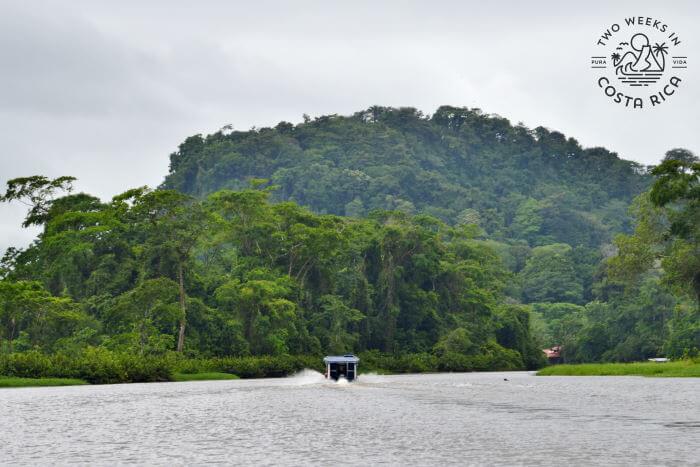
From the SJO area, a private shuttle can bring you to the docks of La Pavona. It’s about a three-hour ride. Taxi boats leave this riverside town several times a day on a set schedule. See our Getting to Tortuguero post for more information.
Additionally, some lodges in Tortuguero have their own boats that can pick you up at the dock. The boat ride to Tortuguero is a little over one hour and is very scenic.
Flying to Tortuguero
Some of the bigger lodges in Tortuguero include flights from San Jose to Tortuguero in their packages. The flight, on a small plane, is only about one hour. Currently, we don’t recommend flying because of safety and reliability concerns in the last few years. However, many people still travel this way. If you would prefer, your hotel may have a shuttle van and boat option as well.
What to Expect in Tortuguero
Tortuguero is a small village on Costa Rica’s northern Caribbean coast. The remoteness of the town and abundant wildlife are its main appeal. There is not much around except thick mangrove forests, winding estuaries, and miles of beach.
The village of Tortuguero sits on a thin peninsula, running parallel to the coast. Most of the hotels and businesses are on the inland side, which has a calm brackish-water estuary. Some lodges are farther up the waterway and more isolated.
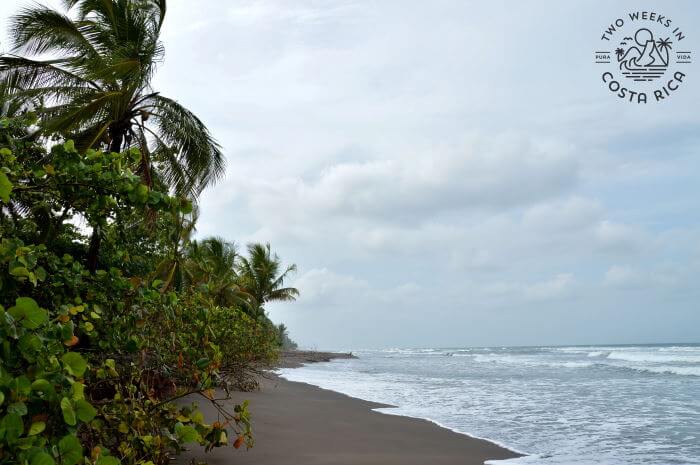
On the other side of the narrow peninsula is the Caribbean Sea. The expansive gray-sand beach is usually too rough for swimming but internationally famous for sea-turtle nesting.
Turtle watching is especially good here during rainy season, which is a big part of why we’re recommending it.
Things to Do in Tortuguero
The main channels of the river in Tortuguero National Park are wide and popular for boat tours. Or you can paddle kayaks or canoes through the smaller creeks and coves.
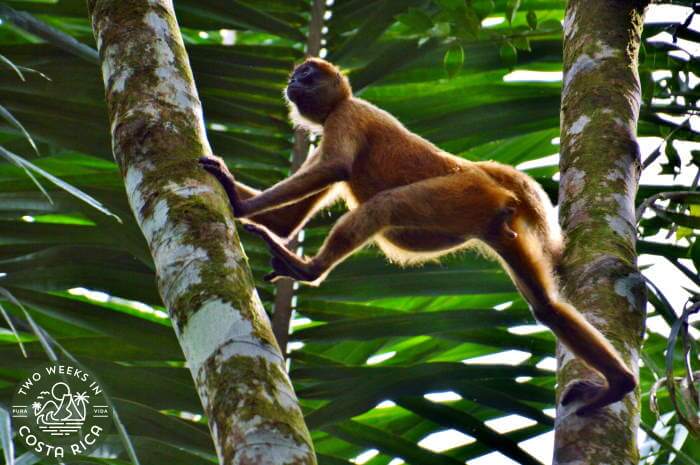
The surrounding forest hosts amazing wildlife like monkeys, sloths, lizards, and many species of tropical birds. The national park has some land trails near town to explore as well.
During rainy season, especially between July and October, you can see sea turtles. They arrive at night to lay their eggs on Tortuguero’s long beaches.
Green sea turtles are the most abundant and easy to spot. Huge, leatherback turtles appear more sporadically on some nights between March and May. Turtle tours are offered through the local guide association. Your lodge also will have a guide that they work with.
For more information about the town, including restaurant and hotel recommendations, read our post, Tortuguero: Off the Resort.
Days 5-8: La Fortuna (4 nights)
Getting to La Fortuna
Unless you have a package with a flight back to San Jose, most travelers going to La Fortuna from Tortuguero pass back through the boat docks at La Pavona. From here, you can either have a shuttle van pick you up or rent a car and have it delivered.
Note: Only a couple of rental car companies service La Pavona. If you are looking for a reliable one, we recommend Adobe Rent a Car. Use our Rental Car Discount page to get a quote. Just select Guapiles/Tortuguero N.P. as your pick-up location and write in the comments section that you need pick up at La Pavona. Cars can be delivered to the docks starting at 11:00 a.m.
From the boat docks at La Pavona, the drive to La Fortuna is about three hours.
What to Expect in La Fortuna
La Fortuna is one of Costa Rica’s most popular destinations and for good reason. The town is situated right next to the iconic Arenal Volcano. Many hotels are spread out around the base, giving picturesque views of the cone-shaped giant. Though these days the volcano isn’t erupting, it is still an amazing sight.
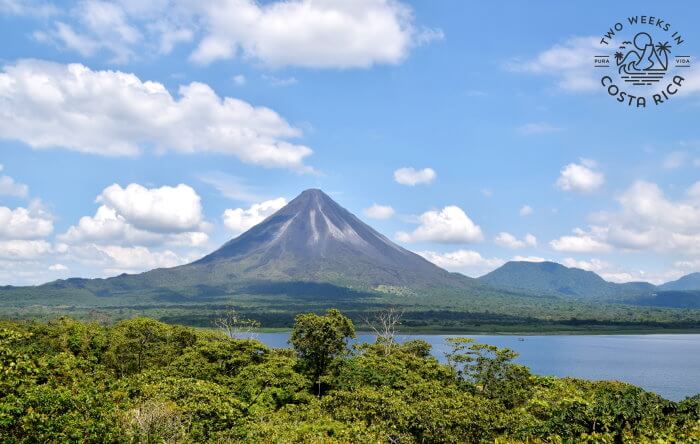
While the volcano is a centerpiece for activities, there is a long list of adventure, nature, and cultural experiences to be had here as well. We always recommend at least four nights in this area, so that you don’t feel like you are missing out.
La Fortuna Activity Highlights
Hot Springs
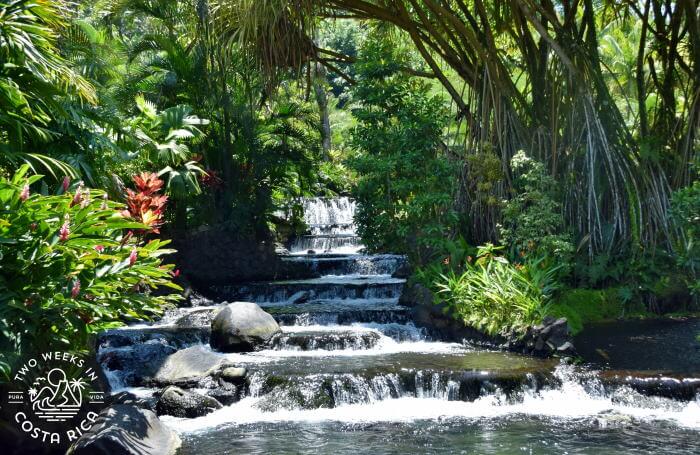
While Arenal Volcano isn’t gushing lava anymore, it still has plenty of power. Underground volcanic activity heats springs and rivers to source the area’s hot spring resorts. Some popular ones to visit are Tabacon, known for its luxury, Baldi, which has more of a fun/party atmosphere, and Ecotermales, which is smaller and peaceful.
Rainy season is a great time to visit hot springs, since a little light rain actually makes for a nice contrast with the warm water.
Wildlife Viewing
Hiking in La Fortuna doesn’t only give you unique views of the volcano. Plenty of wildlife can be seen on the trails as well.
During the day, hikes at Arenal Volcano National Park and the Arenal 1968 Trail are popular. You may see monkeys, frogs, interesting insects, and exotic birds.
In the evening, you can see how the forest comes alive on a night tour. Several are available and offer sightings of sloths, sleeping birds, frogs, snakes, and other creatures passing through. You never know what you will see.
Zip Lining & Hanging Bridges
La Fortuna is a great place to experience the rainforest canopy. You can choose to zip through the treetops on cables or take a more leisurely walk on a series of suspension bridges.
For zip lining, the La Fortuna area has a half-dozen different facilities, ranging from intense to tranquil enough for grandma.
For hanging bridges, there are two main places, Sky Adventures and Mistico Park. Both offer great experiences, but Sky Adventures involves more hiking.

For much more information about La Fortuna, see our destination guide, La Fortuna: What to Expect from Costa Rica’s Most Popular Destination. We also have a hotel guide that may help you choose between the many accommodation options.
Days 9-11: Playa Hermosa, Guanacaste (3 nights)
Getting to Playa Hermosa
From La Fortuna, you can drive or shuttle to Playa Hermosa. Playa Hermosa is in the northwestern part of the country, along the northern Pacific coast. From La Fortuna, the drive is about three hours.
What to Expect in Playa Hermosa, Guanacaste
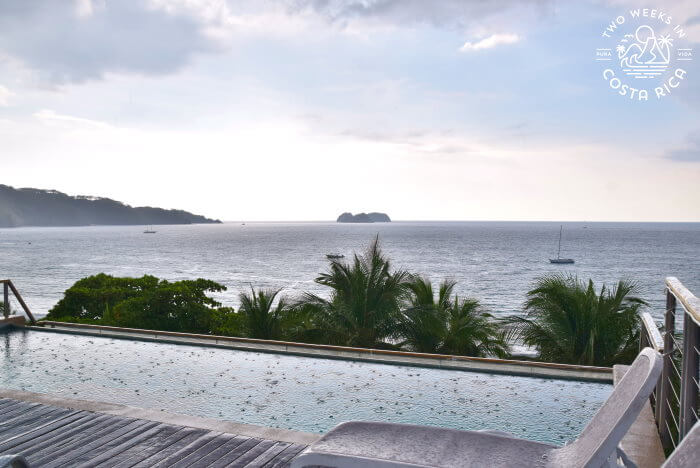
Playa Hermosa is the name for several beaches in Costa Rica. It literally translates to “beautiful beach.” And the Playa Hermosa in Guanacaste Province definitely lives up to this name.
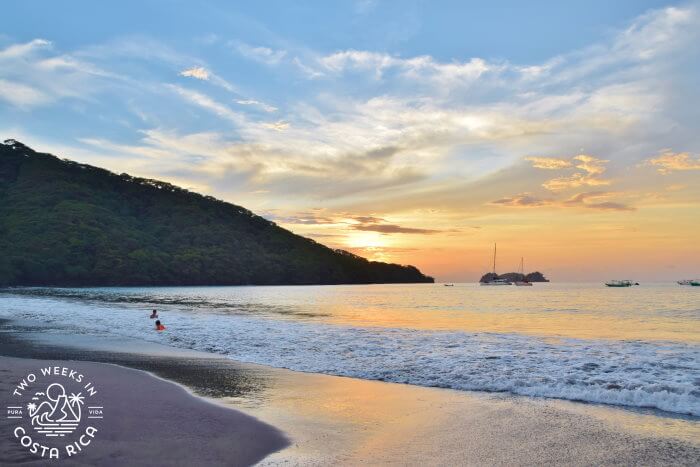
The calmer cove has a nice crescent-shaped beach situated between two points. From under lofty palm trees, you can watch boats float in the harbor and listen to waves swoosh against the shore.
Behind the sand, the relaxed community of Playa Hermosa is made up of part-time condo owners, full-time expats, and locals, who have either grown up nearby or escaped the city to live the beach life.
The small town has a mix of accommodations from hotels and vacation rentals to condos and timeshares. There are also a handful of good restaurants.

Things to Do in Playa Hermosa
After an action-packed first part of the trip, you may want to park yourself on the beach for a few days. But if not, there are some fun activities in and around Playa Hermosa.
Eco-Adventure Park
If you missed out on zip lining in La Fortuna, you can still have a chance in Playa Hermosa. The nearby Diamante Eco-Adventure Park has a Superman-style zip line that gives you the feeling that you are flying. There’s also horseback riding, ATV rides, and some more mellow activities like a coffee demonstration and wildlife sanctuary.
Catamaran Cruise
This area of the country is excellent for catamaran cruises. Though the rainy season may force you to take a morning tour when rain is less likely, it is still well worth it.
Boats depart from Playa Hermosa or nearby Playas del Coco and take you out around rocky points to far-off coves. They then anchor in a secluded spot for some snorkeling, swimming, and lunch. From July to November, you may even get to see some migrating humpback whales. We spotted a mother and baby off a catamaran on one trip in September.
To read more about Playa Hermosa, check out our post, Playa Hermosa (Guanacaste): Costa Rica’s Northern Beauty.
Day 12: Depart Home from LIR Airport
With only a 30-minute drive to LIR Airport, you can enjoy every last minute at the beach before it’s time to leave for the airport. You may even be kicking sand off your feet at the boarding gate.
* * *
With this rainy-season itinerary, you should be able to explore some of the best parts of Costa Rica without getting completely washed out. We hope it helps with your planning and you get to experience our favorite season in Costa Rica for yourself.
Making an itinerary for the rainy season? Leave a comment below.
Looking for more information to help you plan? Check out these posts:
Rainy Season in Costa Rica: How Wet Is It? Read this post to find out what the rainy season feels like and how much rain to expect in general each month.
Planning a Family Vacation to Costa Rica: Essential Tips and Info – Traveling during the kids’ school break? Check out this post for some tips.
Costa Rica and Mosquitoes: Tips to Prevent Zika, Dengue, and More – Prevent bites with some simple preventative measures. Includes recommendations for which insect repellents to use.
Greetings,
Great itinerary. Have visited in 2017, 2019 and 2020. Was thinking of returning with a local birding group but their prices are too high. Any ideas for those who would like to join a group or at least join a group while there? Am really interested in the Pacific Coast.
Thanks for all the great news coverage on addition to the travel advice.
Pura Vida!
Laura
Hi Laura, We don’t know of any birding groups in the country but I’m sure there are some. Sometimes people use groups on Facebook to share a common interest like birding. There is a group called Birding Costa Rica – you could join that and ask about groups where you will be going. Another idea is to hire a birding-specific guide for a national park tour. They will have a lot of local insight about the kinds of birds you’ll be able to observe. Hope that helps!
My husband and 14 y.o. son and I are spending 10 days 7/16-26 in Costa Rica and like off the beaten path (non touristy areas), beauty (for me), nature and some adventure with a few days of surf lessons. We spent time in Nicaragua a few years ago and had the volcano experience. I’d love some ideas. Is Dominical area too rainy??
Hi Suzanne, I don’t think Dominical will be too rainy in mid to late July. We lived in that area for several years and the weather is usually decent that time of year. Up in the mountains it can get rainy early afternoon, but if you stay closer to the coast, it’s more likely to stay dry. It’s a beautiful area and sounds like it would be a good fit for you all, as it’s off the beaten path, has great nature/wildlife, and you can surf.
You could also take a look at our post about off the beaten path destinations in Costa Rica for more ideas: https://www.twoweeksincostarica.com/off-beaten-path-destinations-costa-rica/ The area just south of Tamarindo (Playa Avellanas) may be a good fit too. Hope your family has a great visit!
Hi Jenn and Matt,
Your blog is very informative and helpful and I have enjoyed reading it so far! My husband and I are planning a trip in October and ar thinking of staying in Mal Pas for about a week (trip will be two weeks total) and then heading to Uvita to meet up with some friends for about 5 days. We are both big hikers/outdoors people and don’t mind driving to explore new places. Are there any particular places you highly recommend that we can tack on to see or stay before we head to Mal Pas from San Jose, or between Mal Pas and Uvita? Thanks so much!
Hi Charlene, Maybe the Manuel Antonio area would be good to add. It’s between Mal País and Uvita and there’s quite a bit of hiking nearby – Manuel Antonio National Park, Rainmaker, Los Campesinos, etc. You can check out the links for more information.
We have been fans of your blog for some time and have been wanting to visit Costa Rica for years. We unexpectedly have the next two weeks off. We are about to finalize our travel to Costa Rica from September 27th-October 8th following much of your rainy season itinerary.
Should we rethink the visit because of the rain? We have rain gear, don’t mind getting wet while out exploring and enjoy early morning outings. Or would the weather drive us indoors most days so we wouldn’t be able to hike, snorkel, horseback ride or visit parks?
Hi Jen, Sorry we weren’t able to get back to you in time! We recently moved and things are hectic. I hope you were able to figure out your plans and are having a good trip. Thanks for following our blog!
Hi Jenn and Matt, love your blog. Am planning a trip for my wife, 13-year old daughter, and myself. I thought I posted a questions yesterday, but can’t seem to find. If this is a repeat, my apologies. We are looking at a departure of around May 10, staying in CR 14-16 days. Definites are La Fortuna, Monteverde and Guanacaste (we want 4-5 days of beach, divided between two places – Conchal looks good for one). Beyond that we weren’t sure due to rain, etc. Do Drake Bay and Corcovado make sense? Manuel Antonio? Any other suggestions? Also, we’ll use your car rental discount. At that time, and places we’re visiting, can we make do with a Hyundai, or do we need a 4-wheel? Thanks in advance for my load of questions.
Hi Bodie, If you do 16 days, I think you can fit in both Guanacaste and Drake Bay, but I don’t think I’d try it with less time since those places are far apart and require a lot of travel time. It’s doable with 16 days, though. I’d start in Guanacaste (flying into Liberia if possible), go to La Fortuna, then Monteverde, Manuel Antonio, and end in Drake Bay (flying out of San Jose).
May is the start of rainy season but we’ve found it can actually be fairly rainy compared to June/July. It’s still fine, though, to visit Drake Bay then. Just make sure to have the right gear.
You don’t absolutely have to have 4 wheel drive to go from La Fortuna to Monteverde but it’s recommended during the rainy season. At a minimum, get an SUV with decent clearance. And be sure to leave the car in Sierpe and take the boat taxi to Drake. We don’t recommend that drive, especially during rainy season.
Hope that helps! Thanks for renting your car through our site.
Hi Jenn and Matt, your blog has been great as we plan a trip to CR for us and our two teenaged boys. We’d initially been thinking of an itinerary with three stops over 14 days but are wondering if a single base with trips from there might be a better choice. I’m interested to hear whether this is a good idea and if so, where you’d recommend.
Thanks in advance!
Hi Ann, It’s probably better to pick three destinations rather than trying to do day trips from one location. Destinations in Costa Rica are usually farther apart due to road conditions, making it hard to do day trip from one place. You’ll do less driving overall if you plan on staying in three towns.
Hello, we love your website and it is helping us plan our trip as a family of 5 with 2 teens and a 10 yr. old. thank you so much for all the wonderful info! We have 10 nights and we are trying to decide how best to spend it. Flying in and out of San Jose. We need to spend some time in Tamarindo (surfing for our son) because we have family that have a condo for us there to use. Trying to decide between doing 2 nights La fortuna & 2 nights MonteVerde then head to tamarindo. Or just heading straight to Manuel Antonio for four nights and then to Tama. Or MonteVerde, Manuel Antonio, Tamarindo back to San Jose. Any suggestions just really excited to have rain forest time with zip lining, hiking, adventure stuff.
Hi Lanette, Since you will have beach time in Tamarindo, we would skip Manuel Antonio and do La Fortuna and Monteverde. 2 nights in each place is tough since it’s a longer drive between the two places, so we’d recommend thinking about spending the 4 nights in La Fortuna and skipping Monteverde this trip (unless you have flexibility to take one night off Tamarindo). There is plenty to do in La Fortuna to fill 4 days, no problem. Hope that helps with your decision making!
I loved your article with the rainy season itinerary. I have a couple of questions: If I rent a car in La Pavona area & drop off at Liberia airport, will I incur an extra charge? Also is there anywhere in this itinerary to do snorkeling? That’s something I’d really like to do while there. Thanks for your help.
Hi Tina, There is a charge for picking up at La Pavona. If you rent through Adobe Rent a Car, I think they won’t also charge you for picking up and dropping off at different locations but I would check with them to be sure.
A great place for snorkeling is at a small beach called Playa Penca. This is right next to Playa Hermosa (the last leg of the trip). Note that there is more than one Playa Penca in Costa Rica. The one with the good snorkeling is the one near Hermosa. Hope that helps!
This is such a helpful blog! We’re doing a language immersion week near la Fortuna de Bagaces with various day trip excursions. We first fly into Liberia for the home stay week but return from San José. What would you recommend between Aug 19-23 on way to San José? (must be in SJ by Aug 22 evening so just three nights to spare).
Hi Marnie, You could do Bijagua, La Fortuna, or Monteverde on the way over to San Jose. Bijagua is a very small town, similar to La Fortuna de Bagaces, with some nice attractions like the Rio Celeste Waterfall. Or there’s the more popular La Fortuna/Arenal Volcano area or Monteverde Cloud Forest.
Hi Jenn and Matt, thank you for the wonderfully informative resources! We are planning our first trip to CR, 10 days in late August flying in and out of San Jose and renting a car. We will most likely sleep at Buena Vista hotel on your recommendation on the night we land – then we have 2 days/nights yet to plan before we are due to drive to Santa Teresa and spend 4 nights there. Then we have 1 night to account for, somewhere on the way to La Fortuna area where we will be spending our final 3 nights before driving back to SJ. Any suggestions as to where to spend our two days/nights somewhere “on the way” from San Jose to Santa Teresa and one night between Santa Teresa and La Fortuna area on the way back? Would it be worth it to try and do Monteverde for 1-2 nights? Manuel Antonio on the way out? Thank you in advance!
Hi Charlotte, For your 2 nights before Santa Teresa, you could stay somewhere in the mountains of the Central Valley like Atenas or closer to Santa Teresa, like in Montezuma. Atenas is a nice locals’ town with coffee tours, some nearby waterfalls, and nice views. It has a cooler climate than the coast but is still very pleasant.
For between your time in Santa Teresa and La Fortuna, there isn’t much directly on the way. But one good option is Bijagua, which is where the beautiful Rio Celeste Waterfall is. This is a little out of the way but wouldn’t add too much drive time. It’s only about 1.25 hours to La Fortuna after your time there. It has a different feel – very rural with thick rainforest. Monteverde is an option too but would add more driving. Hope that helps!
Thanks for your articles they are very useful – we’re coming to Costa Rica for three weeks in a few days time. What are the roads like to La Pavona – suitable for a non 4WD car? We have a hire car for the whole 3 weeks and we’re just working out where to leave it when we go to Tortuguero
Hi Rachel, You do not need a 4×4 to get to La Pavona. Some of the road is not paved but it’s flat.
hi. I love your rainy season itinerary. Travelling with an 18 ans 16 year old fir 3 weeks during rainy season, which other destination(s) would you add? thanks for your help.
Hi Kate, With 11 extra days, we would add maybe 2 more destinations and add a night or two onto La Fortuna and the Guanacaste beach destination You could look at Puerto Viejo or Cahuita on the southern Caribbean. The weather is good there from now until early November and it’s a good place with teenagers (especially Puerto Viejo). Then maybe Rincon de la Vieja on the way from La Fortuna to Guanacaste. That’s another volcanic region but a lot different than La Fortuna/Arenal. Follow the links we just gave for more information.
Hello! Thank you for all your wonderful and informative info! My husband and I are planning on going to Costa Rica for 7 days at the end of Oct (we had a good price on tickets so they are already purchased). We would like to go to La Fortuna for sure and thinking of Manuel Antonio/Jaco, should we not even try to go to Jaco because of how wet it will be? Any recommendations on a beach area we could go to that wouldn’t be too wet? Or should we just focus on inland? This is our first time in Costa Rica I don’t mind the rain but I don’t want to be rained out! Thank You!
Hi Mia, La Fortuna is a great option for October and Jaco/Manuel Antonio as well. Although it can be rainy on the central Pacific coast in October, this region has better odds of having decent weather. We have lived in this area for several years. Otherwise, you could go from La Fortuna to a beach town in Guanacaste, which is also a good choice in rainy season. If you’re interested in the Caribbean coast, this area is the best option for weather in late October but it has a different feel. Here’s a link to our Puerto Viejo and Cahuita articles with more information.
Hi Jenn and Matt. I came across your blog based on a suggestion from someone. It has a lot of good information. We are heading there the last week of October into the first week of November. Since we have 3 young ones (under 5), we were planning to take it slow and going to La Fortuna and one other location (originally thinking Manuel Antonio). But I’ve been reading that the rain is heavy at this time for Manuel Antonio. Do you suggest we skip Manuel Antonio and go to Caribbean side instead? We fly in and out of SJO. We haven’t looked into any location on Caribbean coast yet. Also, if we are there for 12 nights, would adding a third location be too much? We plan on spending the last night near the airport.
Hi Dena, The Caribbean side is the best option for a beach town in early November. Typically it’s less rainy than the Pacific coast. Somewhere like Cahuita is nice with young kids, as it’s quieter. The Caribbean is less developed and a little farther, though, so keep that in mind. Manuel Antonio is usually also okay that time of year as long as there isn’t a tropical wave (large rain event). We’ve had many clients in Manuel Antonio in October and early November. Hope that helps!
Hi there. Your blog is amazing!! We are planning a trip with 2 other families (6 adults and 6 young adult/teen kids) around June 27-July 7 (10 days). We are thinking of flying in and out of San Jose and spending 6.27-7.1 in La Fortuna to explore Arenal National Park, zipline and some hot springs then heading to Tamarindo for the rest of the trip. Do you suggest Playa Hermosa over Tamarindo? We would love to stay in walking distance to the beach so people can come and go as they please and be close to restaurants and shops as well.
Hi Amy, For choosing between Tamarindo and Playa Hermosa, it depends on the type of experience you’re looking for. Tamarindo is much busier and has more restaurants, accommodations, and shops. Playa Hermosa is a lot smaller but still has some good restaurants and accommodations close to the beach. You can find accommodations within walking distance to the beach in either place. Another consideration is that Playa Hermosa is better for swimming, while Tamarindo is more of a surfing beach. Maybe it would help to read our full articles about those two destinations (we gave the links earlier in this reply).
Hi,
Thank you so much for all of the info on your blog, it’s been very helpful! I am traveling to CR with my husband and kids (ages 7,9) for 11 days in mid august. I’ve been before many many years ago so am excited to see some new places, namely Manuel Antonio (also thinking of Dominical and puerto Jimenez) and for my family to go. I’m sure we could find plenty to do in that region but I’m wondering if we should plan to travel to other areas of the country in case the rain is bad on pacific coast there ? Considering Arenal for volcano and hot springs and Tortuguero or Puerto Viejo /Cahuita for turtles, sun, Caribbean culture. . Our overall priorities are seeing animals (monkeys, turtles, etc), kid friendly calm beaches, and any kid accessible adventure activities a bonus! I would love to hear which of these places you would recommend given our time frame? Also wondering if there are other good beaches or reserves (besides tortuguero) to see turtles nesting or hatching closer to where we might be? Thank you again! We plan to rent a car and will use your link!
Hi Erin, We would probably skip Dominical and Puerto Jiménez that time of year and focus on other areas that are more likely to have nice weather. It varies by year but can get pretty rainy on the southern Pacific coast in mid August.
The weather in Arenal is usually good then and on the Caribbean coast too. August is a great time for turtle watching so we would definitely add that. With 11 days, you could do three areas. Maybe Tortuguero to La Fortuna to Manuel Antonio. That’s probably the best option. It’s a lot of driving to try to fit in the southern Caribbean and Manuel Antonio. Hope that helps. Best of luck with your planning!
Jenn and Matt,
Please consider dating your posts and articles. You provide alot of great information about Costa Rica on your website, but because there is no way to tell whether the information is 10 years or or one week old, it is of very limited practical usefulness to potential visitors.
Regards,
Matt Lyons
Hi Matt, This post is about 1.5 years old so still completely relevant. This blog is our full-time job so we update posts as needed. When we do an update, we put a new date at the top.
Hi Jenn and Matt,
We’re first time visitors (multigenerational family of 4 adults, two teenagers) planning a 2 week trip in July. Can you please provide feedback on an itinerary including Tortuguero, Monteverde and Manuel Antonio (maximizing time at Manuel Antonio)?
I’d like to primarily use shuttles due to the group size (and luggage amount) and would appreciate a better understanding of travel time between locations.
Many thanks!
Hi Denise, That sounds like a good itinerary for July. July is turtle-nesting season in Tortuguero so that’s a great time to visit.
Those are all major destinations so you shouldn’t have trouble finding shuttles. One thing to note is that the trip from Tortuguero (via La Pavona) to Monteverde could be expensive since it’s farther. Normally, people go from Tortuguero to La Fortuna, which is closer. The time estimates Google Maps gives for these routes should be correct. If you need any help with the shuttles, feel free to reach out through our Private Shuttle Booking page.
Hello,
We are planning a trip early August with our two teenagers. I went in 1991 and know it has changed a lot. I’d like to return to Manuel Antonio and also try Nosara for the first time. How would you recommend we go about that if we have ten days?
Thank you.
Lacy Selby
Hi Lacy, If you want to do Nosara and Manuel Antonio, we would fly into LIR, go to Nosara first, then head to Manuel Antonio, and fly out of San Jose. Those places are both usually fairly nice in August (rainy season). Yes, it will have changed a lot (Manuel Antonio has definitely grown), but hopefully you will still enjoy it. Manuel Antonio is still full of rainforest and beautiful. Hope your family has a great trip!
Hi Jenn and Matt, thanks for all of your expertise. Our family of four (daughters 6 and 9) will be going to CR for the first time this July for two weeks. We are still in the very preliminary part of planning. No set dates or flights yet. We like the pace of the family vacation itinerary you outlined but we’ll be there in rainy season, so we have looked at that itinerary as well. Which itinerary would you most recommend?
Hi Tara, The Family Itinerary would be fine in July as well so go with that if it sounds better to you. The weather is usually good in Arenal then and Guanacaste tends to be one of the driest regions during rainy season/
Hey, I’m planning a trip for 9-22 september. The itinerary I was building pretty much exatly lines up with your proposal for a trip of that time frame during that time of year.
I was hoping to squeeze Monteverde in there as well but that might be a bit optimistic? It does seem like a beautiful place…
We’re flying into SJO from Paris and are also leaving from SJO. If we were to rent a car from La Pavona like described here but would need to get back to SJO, how would you recommend to do it? Or would it be easier to just not drive ourselves then?
Hi Jan, With 13 nights, you could add Monteverde to the itinerary. I would probably do Tortuguero to La Fortuna to Guanacaste to Monteverde to SJO. That would break up the drive back to San Jose. Having a car will be easiest and cheapest (shuttles would be expensive since you’re covering a large geographic area). Hope that helps!
Hi Jenn and Matt, thank you for your reply! How long would you suggest we spend in Monteverde? Would 2 nights/1 day be enough? If it is we can follow the itinerary you suggest in this article and just add Monteverde to it at the end, our flight leaves at 7:35PM from SJ so that leaves us enough time to make the drive back to SJ from Monteverde on the same day our plane leaves back home!
Hi Jan, Yes, that would work. 1 night is OK, 2 would be better if you have the time so you’re not too rushed.
Greeting. After Tortuguero as suggested we want to pickup a car from Adobe in La Pavona and return it to San Jose in a couple weeks. The recommendation to select “Guapiles/Tortuguero” does not exist. I believe “Guapiles/a restaurant” does exist….use that? Lastly then I write in “Comment Section” need pickup in La Pavona…correct? Is a good to confirm this pickup/drop off arrangement with a phone call to Adobe after online reservation? Thank-you much!
Hi William, Yes, it looks like Adobe updated their reservations system so now the pickup location is called “Guapiles – Guarumos Restaurant.” Just do what you suggested and write in the comments that you need pickup at La Pavona. Then, yes, I would confirm by phone or email to make sure it’s all set.
Hi:
I’m planning a 9 day trip to CR at the end of May. I’m thinking in doing Tortuguero,La Fortuna, then Monteverde, Manuel Antonio. do you think is too much. our priorities are. turtles, wild life , volcanoes, snorkeling, cocoa or coffee plantations. I’ll appreciate your feedback
Hi Petra, We would probably cut one destination so that you do only three in nine days so that you don’t feel like you’re traveling too much. Based on your activity list, we would recommend Tortuguero, La Fortuna, and Manuel Antonio. Hope that helps!
Hi Jenn and Matt,
We are unexpectedly going to be in Costa Rica for two weeks at the end of June/beginning of July. We’ll be in Tamarindo for the first week staying in a house we booked two years ago but had to cancel last minute (the kids will be in a language and adventure camp and we’ll be working remotely for the week). We did see Samara and Arenal with a one night stop over in Palo Verde/Rio Tempisque on our way to Samara two years ago. We also visited 20 years ago and saw Monte Verde and Tamarindo, so we’ve seen a lot of the Nicoya peninsula. We fly in and out of San Jose. My quandary is whether to go to Corcovado and/or Dominical — I have especially been keen on seeing Corcovado, but it sounds like it gets a lot of rain and it’s a lot of driving. So instead should we go from Tamarindo to Tortuguero with a stop in La Fortuna to see the volcano again? We didn’t see the town of La Fortuna last time as we stayed at Arenal Observatory Lodge and explored from there. We have a 15 and 13 year old, are pretty adventurous, and will have a car.
Thanks so much for any advice!
-Kate
Hi Kate, Since you’ll be going to Tamarindo, I wouldn’t try to make it down to Dominical or the Osa Peninsula since that would be a lot of driving. Better to go to Tortuguero and La Fortuna. La Fortuna is a great destination with kids those ages. Tortuguero is a good option that time of year too. In general, it has a ton of wildlife and that time of year you can see sea turtles nesting, which is a really cool experience.
In case you’re interested, we just added an online bookings page to our site where you can book tours through us for no extra charge. Here’s the link for La Fortuna. We’ll be adding more tours in the future as well.
Hi Jenn & Matt, we are travelling with another couple in CR this November. The first 2 weeks from Nov 6-20 we’re doing a loop that takes us to Taracoles, up to Baldi, over to Sarapiqui, Heredia, La Paz waterfalls, and back to SJ. After that, my partner and I are taking another week by ourselves. We fly out of SJ, and are trying to decide if we should head to the Nicoya and Guanacaste area for more sunshine, and where to go if thats the case. We prefer to stay away from less touristed/developed areas and instead want to focus on villages, hiking, animal & bird life. Sunshine would be nice and we don’t really want to do a lot of driving. We do have an option to fly out of Liberia, as well.
At the tail end of November, do you have any suggestions for another week outside of the area we’ve already planned? Would the Caribbean side be getting too rainy at that point? Any suggestions welcomed. Your website is really informative!
Hi Lynn, Guanacaste would be good in late November. It’s more likely to be sunny. But you would want to fly out of Liberia since San Jose is much farther. A less developed town there that we love is Samara. It has really nice beaches and some options for hiking and seeing wildlife. In the next week or so, we are going to be adding a Samara section to the tours we book online for people. Feel free to check back or sign up for our newsletter (free) where we will announce it. We work with an excellent naturalist guide there. Last weekend, he took us to his family’s 100 hectare private reserve just outside Samara.