Last Updated: October 6, 2025
Traveling to Costa Rica and exploring its many ecosystems can be an amazing experience. But we get a lot of questions from people who are uneasy about something pattering across the floor or slithering into their suitcase. In this post, we’ll let you know what to expect when it comes to bugs, spiders, and snakes in Costa Rica.
Close Encounters
Overview
The big question for many is how close you might get to these creepy crawlies. After all, seeing them in the wild is one thing, but having a meet and greet in your hotel room or next to the pool is another.
From our experience living in Costa Rica for over ten years, we can tell you that it really varies. The average traveler who is staying in an air-conditioned hotel may not see much in their room. Those shacking up in ecolodges or open-air accommodations could see a lot more.
Common Things to See
In our travels around Costa Rica, we commonly see two things in hotel rooms and vacation rentals: ants and geckos. There is also the occasional cockroach here and there. These critters are mostly harmless and nothing to lose sleep about.
The ants come through to eat any food that is left around or sometimes they nest inside the structure of a building. Costa Rica has almost 1,000 different ant species, so chances are you will meet a few varieties.
An interesting ant that you probably wouldn’t see on vacation but could run into after staying a few months is the army ant. These invade homes by the hundreds in long, organized lines, hence the name. They come in to clean up any bugs that may be hiding in your house. Once they’re done their job, they will happily leave. Most people just let them do their thing and they are gone in a couple of hours.
Geckos (little lizards with suction-cup feet) are very common. They creep around the walls at night but are very skittish around people. They like to eat bugs like mosquitoes that may have gotten into the room. Consider them another part of the cleaning staff, working a 24-hour shift.
Other Critters You May See
Now that we have talked about the most common critters, we’ll cover some that you could see, more rarely. This is especially true if you spend more time in Costa Rica or stay in accommodations that are open air and near the jungle.
This is the part of the post where those who are really scared of bugs, spiders, and snakes can go back to our home page and find a different article to read. Also find an air-conditioned hotel room to stay in!
Insects
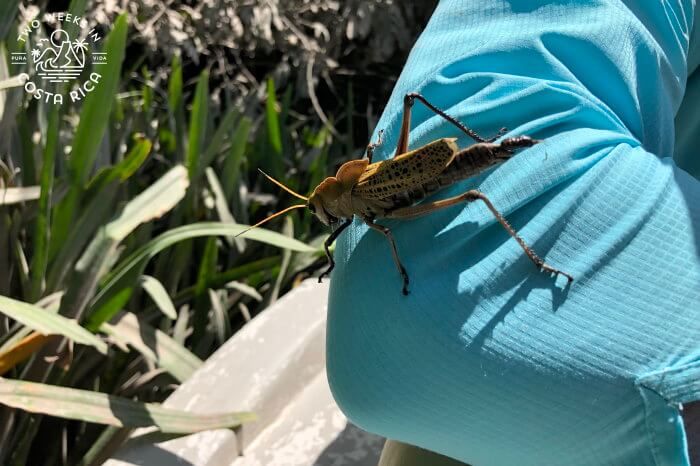
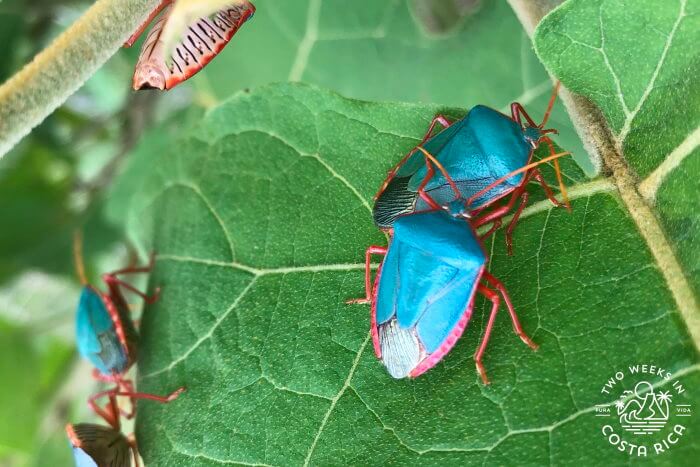
Some scientists estimate that there could be up to 300,000 different insect species in Costa Rica. So far, only around 35,000 have been recorded. With that many bugs, you are bound to cross paths with several dozen species on a given day. Many of these are quite amazing, with flashy colors and intricate body structures. Most are also harmless to humans.
Of course, with any population, there are some more dangerous ones as well. Here are some to watch out for.
Biting Ants and Bullet Ants
Biting ants, known as picas in Costa Rica, are common and can take you completely by surprise. Just one wrong step onto their underground nest or food source, and you will suddenly be dancing up and down.
These ants are normally small and black but can be red too. They swarm to defend themselves and give a stinging bite that often itches afterward. The pain usually goes away within a few minutes and water helps soothe it.
Bullet ants are much larger and have an elongated body. These ants have a sting that gives you shooting pain, like getting shot by a bullet. It can last hours or even a full day but is not harmful. Though we have seen bullet ants, no one in our family has ever been stung by one.
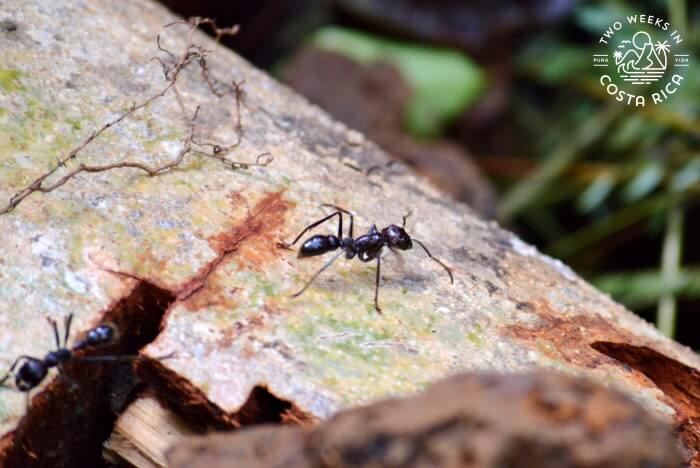
Read our post Ants in Costa Rica: Bites & Stings for more.
Mosquitoes
Everyone knows that mosquitoes leave itchy bites and can spread disease. In Costa Rica, the most common disease from mosquitoes is called dengue. It is most common in the rainier months (May-November) when there are more mosquitoes around.
Other less common mosquito-related diseases in Costa Rica include zika, chikungunya, and very rarely, malaria.
In Costa Rica, mosquito-borne illnesses are most common in agricultural workers or in congested neighborhoods with standing water. Most visitors coming for a short amount of time are not affected. Using insect repellent, window screens, and proper clothing can go a long way in preventing bites.
For tips on preventing mosquito bites, read our post Costa Rica and Mosquitoes: Tips to Prevent Dengue, Zika, and More.
Sandflies
Sandflies are a different type of biting insect that can be dangerous in some areas. These are smaller than mosquitoes and live within forested areas. They are not to be confused with sandfleas, which are found at the beach.
The danger of a sandfly bite is when the fly rarely contains a tiny parasite and transmits it to you when biting. This parasite can cause a sort of flesh-eating wound known as leishmaniasis. Locally, it is called papalomoyo.
Although very uncommon for normal travelers, Matt actually came down with this during our time living in the Dominical area. He had to have daily injections (45 in total) of a powerful medicine to fight it off. He now has a large scar the size of a silver dollar on his leg. Leishmaniasis is said to be most common in the southern forested parts of Costa Rica (both Pacific and Caribbean slopes).
Bees and Wasps
Bees and wasps are important pollinators for Costa Rica’s intricate forests and crops, but many of them sting too. For most travelers, it’s very easy to avoid contact with bees and wasps since they are only aggressive when threatened.
For those allergic to bees and other biting insects, be sure to bring your EpiPen. Also inform your naturalist guides that you have an allergy, just in case.
Keep in mind that Costa Rica has several varieties of stingless bee too. These are black or brown, smaller, and will sometimes hover near your food or drinks at a restaurant. They are harmless and actually produce a delicious honey.
Stinging Caterpillars
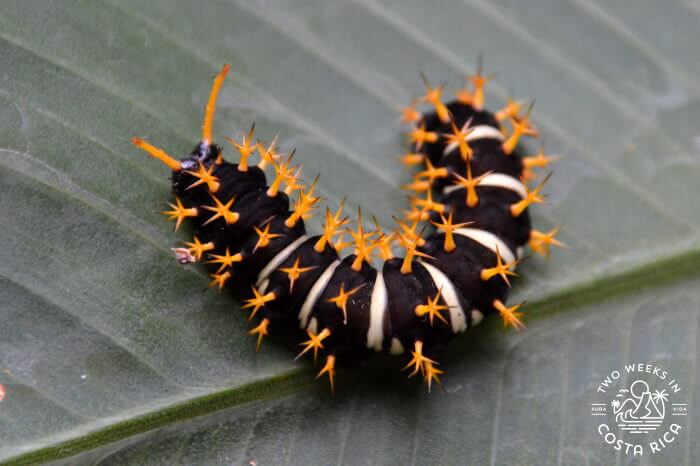
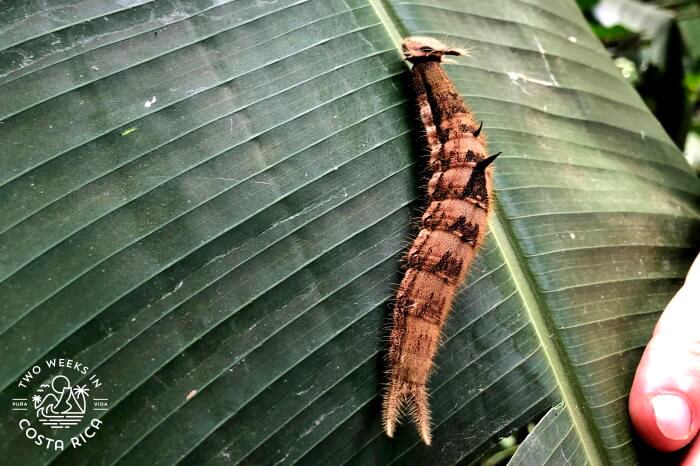
Caterpillars are often looked at fondly since they turn into beautiful butterflies and moths. However, think twice before touching one. Many caterpillars in Costa Rica have fuzzy hairs along their bodies that contain powerful toxins. These protect the caterpillar from predators but can also leave a nasty (non-lethal) sting on your skin.
Our family has been stung by caterpillars a few times. Often, they crawl onto something like an outdoor chair or item of clothing and then we brush up against them. The skin irritation can last for days or even weeks, depending on the species.
Kissing Bugs
This beetle (a type of triatomine insect) is known as the kissing bug, or locally, chinche. It can cause chagas disease when it bites you, and you itch the area.
When this happens, a tiny parasite from the bug’s feces enters the bite and your body. Chagas disease affects the heart and can be fatal if untreated. These bugs are pretty rare and mostly found in poorer communities that have homes without screens, dirt floors, etc. They can occur in other locations throughout Costa Rica, though, and mostly emerge in the home at night. Learn more about these bugs and chagas disease on the CDC’s website.
Spiders & Other Arachnids
Spiders
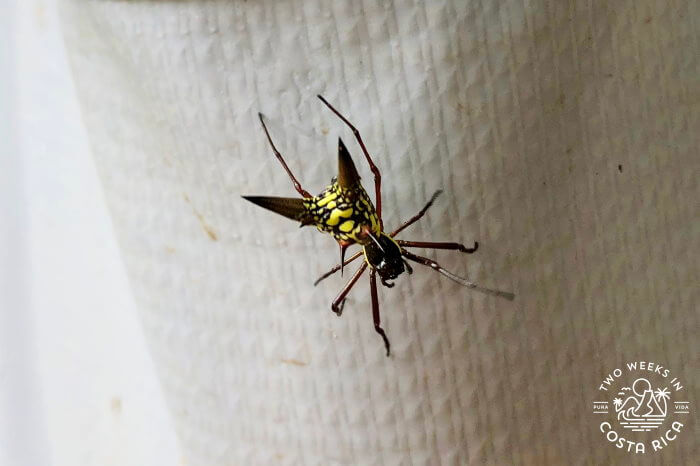
We’re not going to lie, there are lots of hairy, scary looking spiders in Costa Rica. For the most part, they keep to themselves and we keep to ourselves. Occasionally, though, one might enter your house or hotel room. These spiders aren’t going to attack you if you leave them alone, but you really don’t want them around.
Spiders like tarantulas and most web-making species don’t bite people. They can actually be quite impressive, and since they catch bugs, beneficial in the garden.
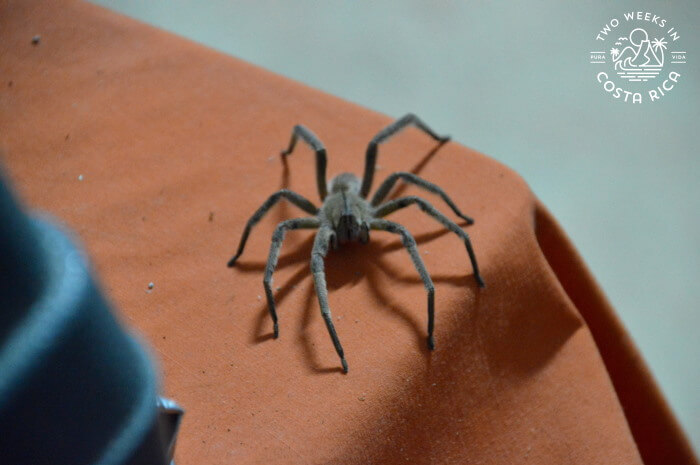
There are some other large spiders, though, that are dangerous. The most infamous is the Brazilian wandering spider. Its bite can be deadly to smaller mammals. Medical attention is usually needed for humans. We have never seen one.
We have, however, seen several different types of wolf spiders. These can give a nasty poisonous bite. Wolf spider bites are uncomfortable and can cause pain and inflammation but don’t usually require medical attention, unless you have a severe reaction.
Scorpions
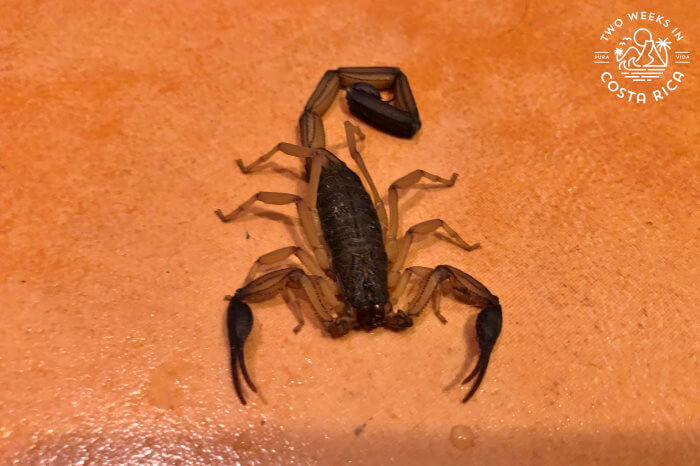
Scorpions are very common in Costa Rica. Although they can give a painful sting, they are not lethal. A University of Costa Rica article explains that it is actually sort of a mystery, since the two types found here are closely related to lethal varieties in other countries. Maybe they are just too happy and pura vida to make stronger poison? We’re not sure.
Scorpions often enter homes or sometimes hotel rooms to find cool, dry shelter. Occasionally, they crawl between stacked clothing or into shoes.
In our experience, they are more active when the seasons change. For example, when it transitions from rainy season to dry season, we often find a few in the house. We usually see them under the stove or refrigerator, or in the closet. We have yet to be stung.
Many hotels spray pesticides for scorpions so there is a good chance you won’t see one during a short visit.
Ticks
Ticks do live in Costa Rica, but with all the traveling we have done, we’ve only had them on us a few times when hiking in really remote areas. They are a bigger problem for dogs and cats, especially since they can cause a disease known as ehrlichiosis. If left untreated, this can kill the animals.
Lyme disease, which is more common in other countries, has not seemed to spread to Costa Rica so far.
Snakes
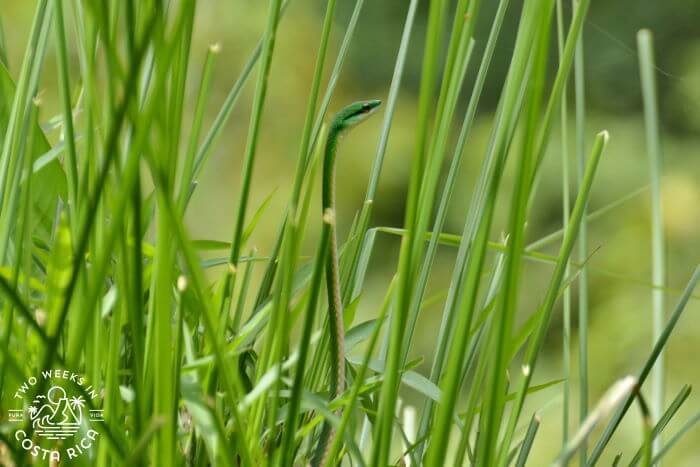
The thought of a slithery snake often makes people cringe. But snakes are an important part of Costa Rica’s ecosystem. They can be quite fascinating too. And what most people don’t realize is that most species are not venomous.
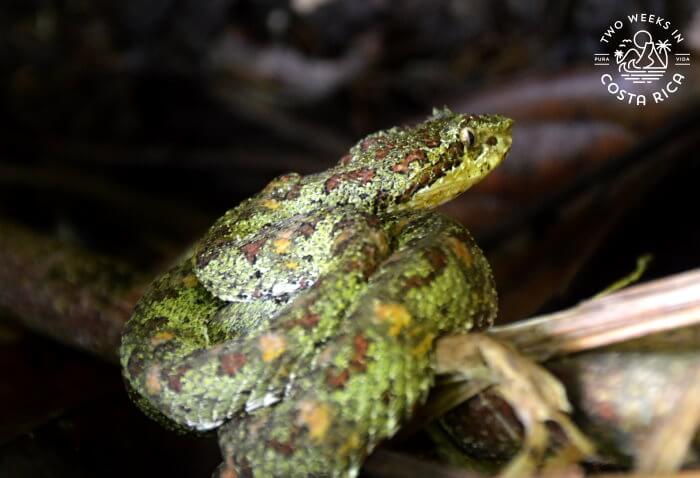
According to the University of Costa Rica, of the 140 species of snake found in Costa Rica, only 23 are venomous. The chances of running into one of these 23 types on a normal vacation is very slim. If you do see one, it will probably be on a tour where the guide has pointed it out to you. Usually, snakes won’t be directly on the main trail where people frequently walk either.
Of course, snake encounters do happen. One family who we helped with trip planning reported a big surprise to us. A six-foot-long boa constrictor had coiled up in the shower of their hotel room! It was the presidential suite at a fancy resort, but all the doors had been opened up during the day and the jungle was just a few feet away. The staff quickly removed it!
During our more than 10 years of hiking in Costa Rica, we have seen a snake cross the trail in front of us only a handful of times. At home, we have seen maybe a dozen snakes pass through our yard, a few coil up on our patio, and a very small one enter the house (under the door sweep). Most have been non-venomous, usually a vine snake or boa, but we have seen some dangerous ones.
As far as venomous snakes go, the most feared in Costa Rica is the fer-de-lance (Bothrops asper). It is known locally as the terciopelo. This snake is responsible for over 50% of snake bites in Costa Rica.
On average, around 500-600 snake bites are recorded in Costa Rica annually. Luckily, the country has one of the most well-respected antivenom laboratories in the world, and deaths from snake bites are very low.
Costa Rica’s Instituto Clodomiro Picado has developed highly effective medicines to combat the human body’s reaction to a poisonous snake bite. This technology saves all but one or two snake-bite victims per year, mostly because they had to travel too far to get the treatment.
Public hospitals in Costa Rica have antivenom on hand in the unlikely event you do get a snake bite. In very rural areas, we have heard of veterinarians providing the antivenom as well. For information on what to do if you get bite by a snake, here is a useful article.
Conclusion
If you are letting some of Costa Rica’s less-desirable creatures prevent you from coming, don’t. Your chances of having a big hairy spider on your pillow or a snake coiled up in your shower are extremely low. If you keep to the main trails and attractions, close up your accommodations, and use insect repellent, you should be able to put all your fears behind you and enjoy everything that this beautiful country has to offer.
Have a question about bugs, spiders, or snakes in Costa Rica? Or maybe a story to tell? Leave a comment below.
Looking for more information to help you plan? Check out these posts:
Why to Get Travel Insurance When Visiting Costa Rica – Being prepared for the unexpected is the way to go. Travel insurance can help cover not only travel mishaps or delays but unexpected health emergencies too!
Jellyfish and Stingrays in Costa Rica – Learn how likely it is to see a jellyfish or stingray at the beach in Costa Rica.
Health and Safety – View all our health and safety articles for information on drinking water, vacation rental safety, beach safety and rip currents, and lots more.
Safety Tips for Your Next Trip to Costa Rica – Crimes can happen on vacation but most can be prevented with some simple measures.
Practical Travel – Get more basic travel info about the weather and best times to visit, using credit cards, exchanging money, and transportation.

We have a mild phobia with geckos showing up in our hotel rooms. Iv been trying and searching really hard for places that would be sealed enough to minimize the chances of geckos being present in a hotel room or Airbnb. From your travels in and around La Fortuna, the Central Valley, Manual Antonio, Tamarindo, Samara and Playa Hermosa, have you stayed in anywhere that was well sealed to discourage gecko presence in rooms? Recommendations would highly be appreciated. Would love to get your opinion on this.
Thanks!
Hi Ali, Geckos are really common in Costa Rica but you typically don’t see them in hotel rooms that have air conditioning because they are better sealed. There’s no true way to tell in advance if a hotel will have them but if you go with a more upscale hotel, you should be okay. Hope that helps.
I just read your post on CostaRica critters.
We own a home in Playa Naranjo, Nicoya, near the ferry landing. It is hot and dry, and we have minimal mosquito issues.
In January, we visited Palo Verde, in hopes of seeing Roseate Spoonbills (as advertised in all the info on the area). Mosquitoes don’t bother me much, but I got more mosquito bites in the first couple hours there than I have probably gotten in my entire life combined (I’m 70). After those first couple hours, I used spray, long pants, and long sleeved shirt. A few days later I noticed a bug bite on my back. It was small like a pimple, but by the time we flew back to the States a couple days later, it was the size of a nickel. The day after I got home, I went to see my surgeon friend, and he scheduled me for surgery the next day. By then it was a 5 inch MRSA abscess, and I was left with an open surgical wound that my husband and I needed to wash out and bandage daily. It took a month to close. Our Costa Rica property manager thought it was probably due to a bot fly, and the surgeon agreed, though he didn’t find eggs or larva in the wound. Other ideas?
And…no roseate spoonbills 🙁
I wouldn’t recommend Palo Verde, as it is not much more than a swamp.
And, by the way, our workers have killed rattle snakes (translated from Spanish as “jingle bells”) and a coral snake on our property. We have also had 6 inch+ tarantulas in the house on several occasions (climbing the walls and sleeping on the window sills). Their motion has even set off the burgler alarm a few times.
And I have had a severe reaction to an Herba Santa plant that grows around our home, with resulting pain, swelling, purple discoloration, and soft tissue/skin necrosis on my arm and face. I could go on…skunk in the drained pool during maintenance, skunk in our recycle can, rabid coatimundi peeing in the pool, scorpions, stinging ants, black vultures pooping (or vomiting?) on me from the rooftop, swarming bees, iguanas loose in the house, and lots of critters our workers bring to show me. Francisco said “Blue means DANGER” when he showed me a large blue centipede.
Geckos are NOTHING! And…don’t touch the toads!! They lay eggs in our pool. In a two week time span, friends lost 2 dogs to toads, another lost a dog to a rattler, and a 3rd friend’s dog was eaten by a crocodile. Never a dull moment in CostaRica. You just gotta love it.
Good stuff: we’ve seen deer, coyote, howlers, white faced monkeys, coatis, skunks, ocelots (dark morph and regular), foxes, iguanas, cool snakes, lots of interesting butterflies/moths/cocoons, and amazing birds on our property.
Quick question: Any idea where or how Matt got the sand fly bite in Dominical (beach, forest trail, etc) and the time of day? I want to go there and Drake Bay (with a day tour into Corcovado) in July but I’m starting to get paranoid about leishmaniasis. The more I read it seems pretty horrifying. I have a youngster with a slightly lowered immune system and want to be cautious.
Hi Jeff, We were living in Lagunas de Baru (in the mountains behind Dominical, about 10 minutes from the beach) at the time and think it probably happened there, but aren’t sure.
Great article
We are traveling to Costa Rica in December and staying at the Riu resort in Coco province. We have heard a lot of comments about the sand fleas and were wondering how big of an issue that will be in December. Will also need to book a shuttle from the airport to the hotel and back to the airport
Hi Ed, We haven’t stayed at the Riu so aren’t sure about sand fleas. We’ve really never seen them in Guanacaste before, though, in all our travels. Including when we’ve been to Playas del Coco and nearby beaches.
If you’d like help booking an airport shuttle, here’s the link to our site for LIR Airport to Riu.
There was a kind of spider mite I got on me in Rincon de la Vieja when I was camping there in my hammock with a mosquito screen. They would burrow beneath my skin and it would itch a lot. I believe I got them on me from a rock I sat on by the water. I had peppermint oil that I would rub on my skin to kill them off, or prevent them from biting. The mosquitoes weren’t a problem, but the noseeums at the beach in a couple places bit in the morning and nights. I would wear a hoody and pants, and socks to protect those areas. The downside was that they could get through the screen. Same with black flies, but the flies would get confused and go to the top instead of biting me. I have a hammock I can close off by putting it over me, and so I was protected when sleeping though.
Hi. We have had 2 wonderful holidays in Costa Rica and your site was invaluable. I didn’t read this article before we went as we aren’t too bothered by creepy crawlies. But on our return in March 2022 we both developed sores and my husband’s became really bad. Mine healed but his were being dressed each week and got progressively worse. It took a long time to get the Leishmaniasis diagnosis (we live in he UK) He finally starts tablets for this tomorrow. The list of possible side effects is not great but hopefully it will kill it off. He is going to have huge scars. We had 5 days in Domincal which was lovely but I wonder if that’s where we got it too. We were completely unaware of any sandflies but were bitten by what we thought must be mosquitoes.
We aren’t put off our travels though! We are nearly 70 and have traveled all our lives. This is our first unfortunate encounter!
Hi Sheila, What bad luck, very sorry to hear this happened to you. We have friends who have lived in the Dominical area for several years who have never gotten it so it’s kind of crazy that you and your husband contracted it during a vacation. Hope he is feeling better and healing.
What about bugs et al on the beaches? There must be sand fleas as there are just about everywhere, but anything else of note? Snakes? And what about in the water? Sharks, octopuses, etc.?
Hi Bev, Sand fleas at the beach are not common in Costa Rica. During certain times of year, there can be small jellyfish in the water. We have only encountered this a few times in our nine years here, though. Sea snakes are possible to see, but rare. Sometimes they get washed up on the beach. No problem with sharks. Crocodiles are something to be aware of at beaches that have rivers nearby. Not a big problem, but there are occasional sightings.
Very nice article.
This will be my third time going to CR in October for almost 3 months as a digital nomad and I hope I will see as many insects as possible 🙂 CR has very beautiful nature and I hope it will stay that way for many many years!!!!
Hi. Thank you for all the information as well as taking the time to reply to messages. I have a somewhat general question. Are you familiar with Parrita? Do you know how it would be to live up in the mountains in Parrita? I’d appreciate any information you may have about that area. Thanks so much! 🙂
Hi Michaelina, We used to live about 15 minutes from Parrita but near the beach. The mountains near Parrita are very quiet. There’s not much there, other than the main town area of Parrita. Parrita is a locals’ town with no tourism. There are some expats who live there. Parrita is sort of off on its own. The nearest bigger destinations are Jaco and Manuel Antonio. Hope that helps!
How prevalent are sand flees in various areas in Jan/Feb? Do the products you recommend for mosquitos prevent sand flee bites as well? Thank you so much for all the great information you provide!!
Hi Nava, Sand flies seem to be the worst during transition times – like between dry and rainy season. This is in late April-May approx. Yes, the same products should help prevent bites.
I was asking about sand FLEES or no see ums on the beach, not sand flies. Is that what you were responding to? Love your site. Thanks for answering so promptly!
Yes, the repellents should also work on sand fleas. People also just use a natural oil-based repellent for sand fleas and it works well.
I will be visiting Costa Rica soon for the first time. I will be near the jungle, in the south. No air conditioning. Do you have any bug repellent tips for the hotel room and or sprays, brackets, etc for my body? Also, we will be hours from the nearest hospital, are there additional precautions I should take? Thanks!!
Hi Heather, Hopefully your hotel room will have screens so that the bugs don’t get in. For when you’re outdoors, we use Picardin, which is similar to Deet but is supposed to have a better safety profile. You can also use some of the more natural essential oil-based repellents if it isn’t too buggy.
We would bring some lightweight pants with you in case the bugs are really bothering you. Mosquitoes can’t bite through the nylon hiking kind. Here is a link to our post on Mosquito Clothing with more information.
Hi there – I’m really enjoying your posts. I heading to Nosara in 3 weeks and have 2 questions:
1 – should we bring CR currency or US$ or both?
2 – we are arriving at Liberia and want to ensure we take reliable and safe transport to Nosara. Do you have any advice for us i.e. name of a shuttle company? Thanks a lot!
Hi Claudette, Glad our posts have been helpful!
Here’s a link to our Money Matters article, which should answer your question on which currency to bring.
For a shuttle, we actually book shuttles and have a network of different companies that we use throughout the country based on route and price. They are all reputable and reliable. If you’d like us to help with your arrangements, here’s the link to the page for the shuttle from LIR Airport to Nosara. Let us know if you have any questions. Thanks!
Thanks very much for the information, especially regarding the airport shuttle.
I want to book it but I have only one concern. When my friend booked our accommodations (Che Nosara), she indicated that we would like transportation but they haven’t replied to our messages inquiring about the name of the service or even a confirmation that it has been arranged. We don’t want to risk having 2 companies picking us up. That is our conundrum. Any suggestions would be greatly appreciated.
Hi Claudette, Sorry we forgot to reply to this. We would contact your accommodations to see if they reserved it. Sometimes communication isn’t great here so it’s likely that they did even though you didn’t get a formal confirmation.
Well hi. I am coming to CR for the third time in may. I actually LOVE insects. Am I going to see much at that time o of year?
Hi Diane, There are lots of bugs year-round so you shouldn’t have any trouble in May. That is very early in the rainy season anyway.
How did you get your household belongings to Costa Rica
Hi Jennifer, We moved 11 years ago before we had kids. We didn’t bring that much so carried everything in suitcases. Here’s an old post about that. A lot of people ship a container or partial container to get their stuff here. Many others just rebuy everything once they arrive to avoid the hassle.
file:///var/mobile/Library/SMS/Attachments/eb/11/1F5A181C-E56E-4F87-B2B2-DAF68DE7117A/2f11fbad-d57f-40e7-8c74-50c9f1e98919.mov
Why don’t you accept my post about us living in the jungle in Puriscal?
Hi Peter, We receive a lot of comments so sometimes it takes us some time to get back to people.
The best way to lessen the amount of unwanted visitors you have is to make sure your property is cut back around your house. We have a lot of pristine jungle around us, and when we first moved into this house, we saw snakes, spiders, etc. in our backyard. We’ve since done some landscaping to cut back fruit trees that snakes like to hang out near and do general pruning and maintenance like raking away leaves. You’ll notice that most Ticos have their yard cut back around their house for this reason. Also make sure you have door jams to prevent things from slipping in under the cracks. A lot of it is seasonal and can’t be helped, though. We get things like any invasions during certain times of year. Seems inevitable with all the nature around us. Hope you’re able to get it under control. Good luck!
We live in the top of the mountains in Grifo Alto.
We get tarantulas and other big spiders in the house and scorpions, and the Fer de Lance is frequently killed by the gardeners.
What can we do to keep them out of the house?
We have sealed every place we could find that they could enter but still get them. I am terrified.
Thank you for your excellent posts. I live part-time in Limon province and use a tool called a therapik as an instant cure for bee and scorpion stings as well as sand flea bites. I consider it a must have tool for living in the jungle.
Hi David, We hadn´t heard of Therapik but it looks interesting. Thanks for the tip!
I have not been there yet but I’m excited but scared too cauze ove all of the deadly snakes
Yikes… glad I read this after my visit!